Lesson 12 | Bitcoin's Secret Clock: Halving and Mining Explained
For beginners, in plain English
In Lesson 01, I told you there will only ever be 21 million Bitcoin. A lot of people nod at that line and move straight on. But it is the most important sentence in all of this, and today I want to show you the machine that actually makes it true.
Anyone can promise "we will never make more." Governments promise it all the time, right before they print another trillion. What makes Bitcoin different is not the promise. It is that the promise is built into the machine, on a schedule nobody can change, running quietly in the background since 2009.
Once you see how that clock works, Bitcoin stops feeling like magic internet money and starts making a lot of sense. Grab a coffee. Let's open it up.
What "Mining" Actually Means (It's Not What You Think)
The word mining makes people picture pickaxes and gold. That picture is half right, and Satoshi actually chose it on purpose, but let me give you what is really happening.
Quick word on Satoshi, because the name keeps coming up. Satoshi Nakamoto is the person, or possibly the group of people, who invented Bitcoin. In 2008 they published a short document explaining how it would work, launched it in 2009, then quietly disappeared around 2011 and were never heard from again. Nobody knows who they really were.
Here is the detail that matters: Satoshi mined around a million Bitcoin in the early days and has never touched a single coin. Never sold, never spent, never cashed in. The inventor walked away and left the whole thing to run on its own, with no founder pulling strings behind the curtain. That is not an accident. It is the entire point. Bitcoin was built to belong to no one, so no one can change the rules.
This is where it quietly does its job against inflation. Remember the money-printing problem from Lesson 01, where every new dollar makes yours worth a little less? Bitcoin was designed to do the exact opposite. Instead of getting easier to make more of, it gets harder, on a fixed schedule, automatically. While your dollars are being watered down over time, the supply of Bitcoin is tightening. That is the whole reason so many families started treating a little of it as a way to hold value rather than watch savings leak away.
Bitcoin has no bank in the middle. No head office keeping the master list of who owns what. So somebody has to do the job a bank normally does: check that every payment is real, that nobody is spending the same coin twice, and write it all down in a permanent record.
That record is the blockchain. And the name tells you exactly how it works.
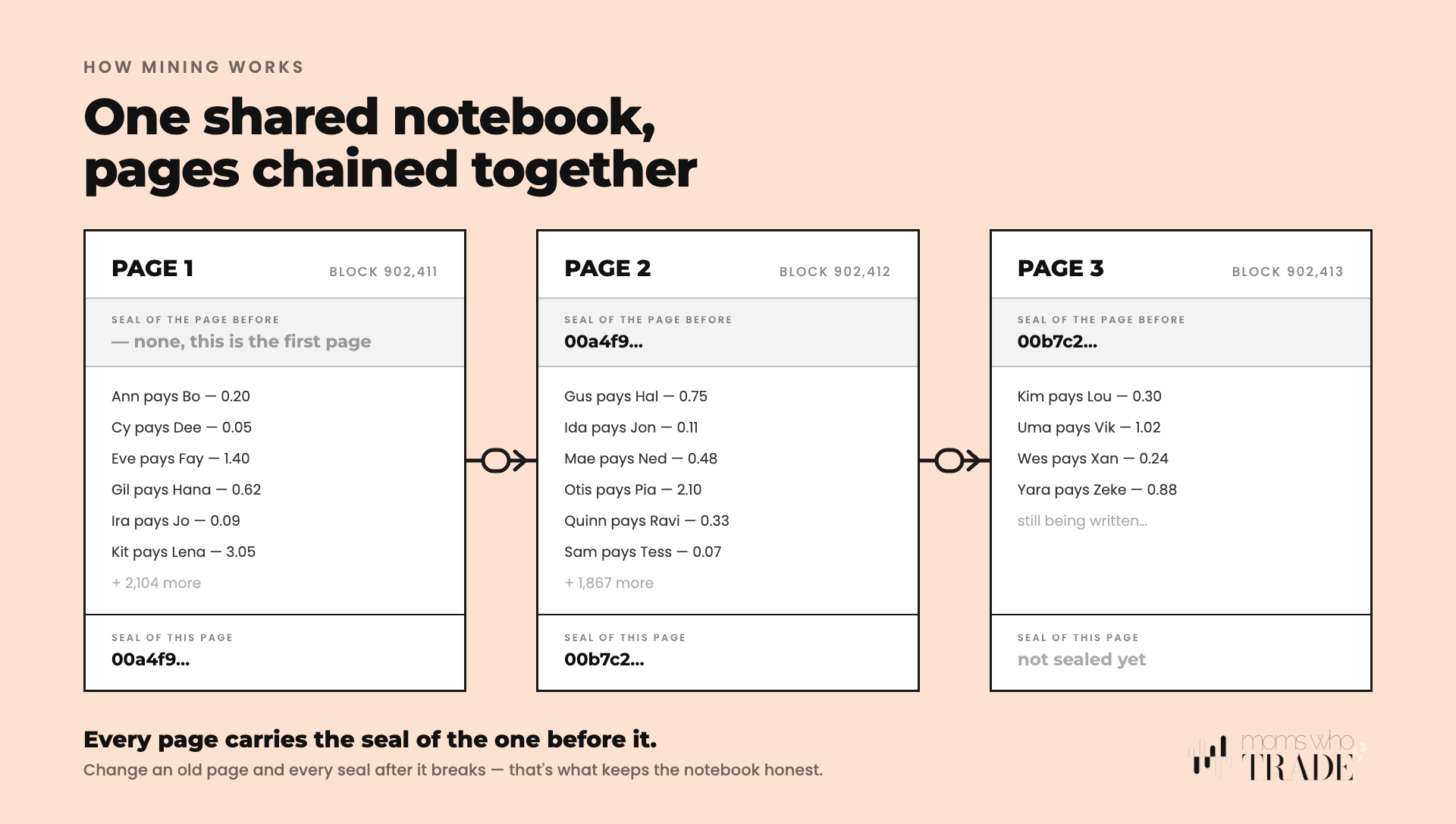
Picture a notebook where payments get written down. Every ten minutes or so, the latest batch of payments gets grouped together onto a single new page. That page is called a block. Each new page has the previous page's fingerprint stamped onto it, so every page is locked to the one before it, in order, like links in a chain. A chain of blocks. Blockchain.
Why does that matter? Because it makes cheating impossible. If someone tried to sneak back and change an old page, its fingerprint would change, which would break the next page, and the next, and every single one after it. The whole chain would fall apart and every computer in the network would instantly reject it. You cannot quietly edit the past. It is all stitched together.
So who writes these pages? The miners. All over the world, they run powerful computers that gather up the latest payments, check them, and race each other to be the one that gets to add the next page. Winning that race takes real electricity and real computing power. This is what people mean by proof of work. You cannot fake it or shortcut it, you have to actually spend the energy, and that spent energy is what makes the whole record so hard to attack. To rewrite history, a cheater would have to out-power every honest miner on earth, all at once. Not worth it. That is the point.
So why would anyone spend money on electricity to do the world's bookkeeping? They would not do it for free. So they do not.
How New Bitcoin Is Born
Every time a miner wins the race and adds a new page to the chain, they earn a small amount of brand-new Bitcoin as their reward. When people say miners "mine Bitcoin," this is what they mean. They are not digging coins out of the ground, they are earning newly created Bitcoin as payment for adding the next verified page and keeping the record honest.
That reward is how every single Bitcoin comes into existence. There is no factory. No mint. No pile of 21 million coins sitting in a vault somewhere waiting to be handed out. Each new coin is born, a few at a time, every ten minutes, as the prize for doing the work.
Which means most of Bitcoin's supply is not floating around the market yet. It has not been created. It is still locked in the future, waiting to be released slowly, one block at a time, over the next hundred-odd years.
Satoshi described this in the original document: new coins entering the world through mining is like gold miners spending resources to add gold into circulation. Except here the resource being spent is computer power and electricity. That is the digital gold idea from Lesson 01, except now you can see the actual shovel.
So that is the engine. Miners spend energy, keep the record honest, and get paid in brand-new Bitcoin for doing it.
If that reward just kept flowing at the same rate forever, you would have the exact money-printing problem Bitcoin was built to escape. This is where the clock comes in.
The Halving: Bitcoin's Built-In Clock
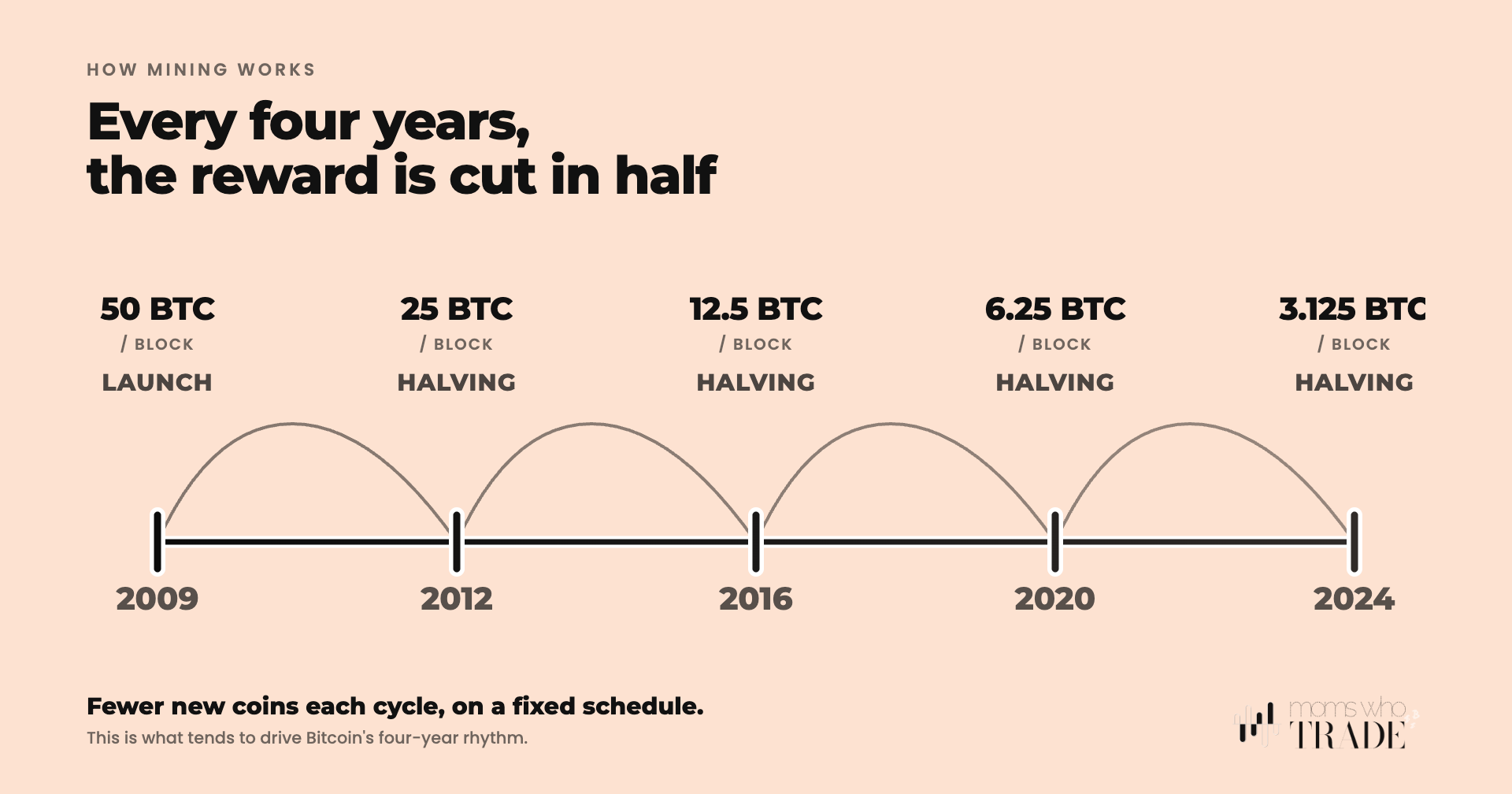
Roughly every four years, the reward miners get for winning the race is automatically cut in half. That is it. That is the halving. It is written into Bitcoin's code, needs nobody's permission, and has happened like clockwork since day one.
Most explainers skip this detail: the halving is not set to a calendar date. It is set to a block count. Every 210,000 blocks added to the chain, the reward halves, full stop. Since a new block lands roughly every ten minutes, 210,000 of them works out to about four years. The clock is not counting dates, it is counting work done. No government, no company, and no bad year can rush it or stall it.
Here is how the reward has shrunk across each era:
- 2009: 50 Bitcoin per block
- 2012: 25 Bitcoin per block
- 2016: 12.5 Bitcoin per block
- 2020: 6.25 Bitcoin per block
- 2024: 3.125 Bitcoin per block (current)
- 2028: approximately 1.5625 Bitcoin per block (next halving)
Every four years, the tap that drips new Bitcoin into the world gets turned down by half. Slower and slower and slower.
You might be thinking: if it is already down to about 1.5 by 2028, surely it is basically finished? It does not stop at 2028. It keeps halving every four years, more than thirty more times. Each cut is tinier than the last, so the tap never quite slams shut, it just drips slower and slower toward nothing. Add all those ever-smaller drips together and they stretch out for over a hundred years. The very last tiny fraction of a Bitcoin will not be mined until somewhere around the year 2140. After that, no new Bitcoin will ever be created. Not one.
That is how "only 21 million, forever" goes from a promise to a fact. Nobody enforces it with a rule they could later break. The math simply runs out.
And if you have ever wondered where that oddly specific 21 million comes from, this is the answer. Nobody sat down and chose it as a nice round target. Add up every reward across every four-year era, halving forever, and the total quietly lands just under 21 million. The cap is not a separate rule bolted on the side. It is simply the sum of the halving schedule.
We are already more than 95 percent of the way there. Over 20 million already created, fewer than a million left to go. That last portion will keep trickling out in smaller and smaller amounts for the rest of our lifetimes and well beyond.
The Clock That Keeps Itself Accurate
Every four years, the flow of new Bitcoin gets cut in half. At the same time, the number of people who want it keeps growing.
Mining is not a hobby in someone's garage anymore. It is a global industry. Warehouses full of machines chasing the cheapest electricity on earth. Those miners have real bills to pay, so most of the Bitcoin they earn gets sold straight onto the market to cover costs. They are the biggest source of fresh supply every single day. Cut that reward in half and you cut that supply in half overnight. People call it a supply shock.
Less coming in. Same or growing demand. You already know how that story ends.
This is why Bitcoin has moved in cycles its whole life. Quiet years, then busy years, roughly in step with this clock. I will not promise you what the price does next, because nobody can. But knowing the clock exists, and knowing exactly when it ticks, puts you ahead of most people buying Bitcoin with no idea any of this is happening.
Why The Halving Is Such A Big Deal
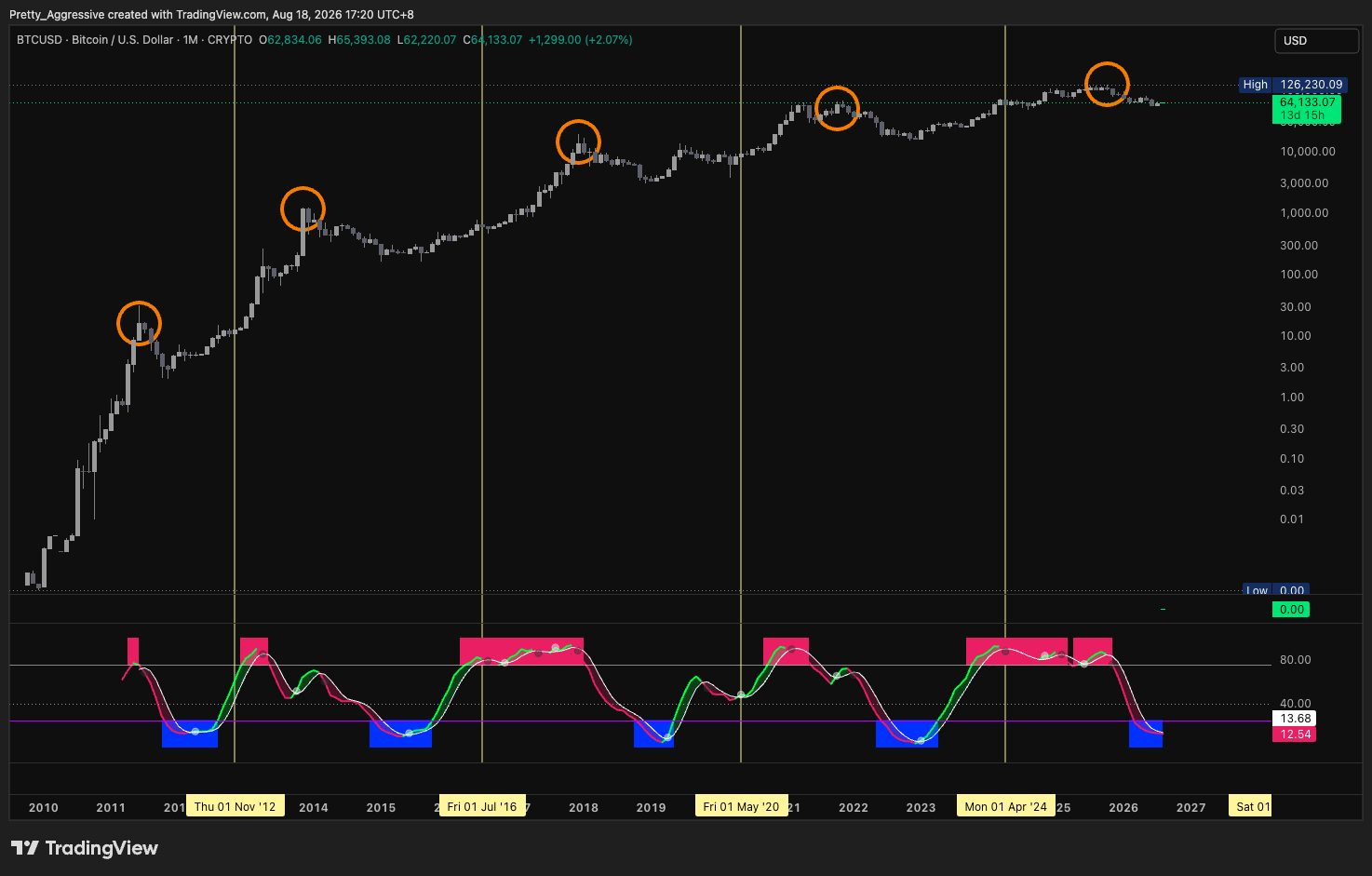
Think about what a halving really does. Every four years, the flow of new Bitcoin coming into the world gets cut in half, while the number of people who want it generally keeps growing.
And to really feel why that matters, picture where those new coins actually go. Mining today isn't a hobby in someone's garage. It's a global industry, warehouses packed with specialised machines, all chasing the cheapest electricity on earth to stay profitable. Those miners have very real bills to pay, so they sell most of the new Bitcoin they earn straight onto the market to cover them. That makes miners the single biggest source of brand-new supply hitting the world each day. So when a halving cuts their reward in half, it cuts that flow of fresh coins for sale in half too, overnight. People call it a supply shock.
You already know what happens when something suddenly gets harder to come by while just as many people want it. The price tends to feel that pressure. It's the same reason a limited-edition anything holds its value while something they print endlessly does not. Less coming in, steady or rising demand. That's the whole story in one line.
This four-year rhythm is why Bitcoin has moved in cycles for its entire life. It tends to have its quiet years, then its busy years, roughly in step with this clock. I'm not going to promise you what the price does next, because nobody honestly can. But understanding that this clock exists, and that we all know exactly when it ticks, is a genuine edge. Most people buying Bitcoin have no idea it's even there.
What Happens To Miners When The Reward Runs Out?
Every Bitcoin payment carries a small fee that also goes to the miner who processed it. Right now the new-coin reward is the big part and the fees are small. As the reward keeps shrinking, the fees take over.
By the time the last Bitcoin is mined, miners run entirely on fees. No new supply, ever. That was the design from day one.
So Why Should A Mom Care About Any Of This?
The money in your purse loses value over time. Not because you did anything wrong, but because more of it keeps getting made. The US is nearly forty trillion dollars in debt, growing by around eight billion a day. The way governments deal with debt like that is to print more money. Every new dollar printed makes the ones you already have worth a little less. That is why groceries cost more this year than last while your pay sits still. Your money did not shrink. It got watered down.
Bitcoin was built as the opposite of that. No printer. No one who can decide to make more on a bad day. A supply that tightens on a fixed schedule. That is why so many families keep a little of it, not as a lottery ticket, but as a bucket that does not leak the way the dollar does.
Mom Tip
You do not need to mine anything, run a computer, or understand a single line of code. That is the miners' job, and thousands of them are doing it right now.
Bitcoin's supply is not a promise made by a person who might change their mind. It is a schedule, enforced by a machine, that gets tighter every four years and stops completely around 2140. Not hype. Just arithmetic that does not lie.
You do not have to agree with all of it. But now you actually understand it, and that puts you ahead of almost everyone.
One skill at a time. 🤍 Mel
Frequently Asked Questions
What is the Bitcoin halving?
A rule built into Bitcoin's code that cuts the miner reward in half roughly every four years, or every 210,000 blocks. It controls how new coins are created on a fixed schedule that nobody can change.
When is the next Bitcoin halving?
Around April 2028, at block 1,050,000. The reward drops from 3.125 Bitcoin per block to approximately 1.5625.
How many Bitcoin are left to mine?
Over 20 million of the 21 million total have already been mined, more than 95 percent. Fewer than a million remain, releasing slowly in ever-smaller amounts until roughly 2140.
What is Bitcoin mining in simple terms?
The work of checking Bitcoin payments and recording them permanently, done by computers worldwide. Those computers earn newly created Bitcoin for doing it. That reward is how every coin comes into existence. There is no factory or mint.
Why is there a 21 million Bitcoin limit?
It is not a separate rule. It is the mathematical result of the halving schedule. Add up every miner reward across every four-year era, halving each time, and the total lands just below 21 million. Every computer running Bitcoin enforces it automatically. Nobody can change it.
Do I need to mine Bitcoin to own it?
No. Mining is a specialised job. To own Bitcoin, you simply buy it through an exchange, the same way you would buy anything else.
How does a block stay at ten minutes if more miners keep joining?
The network adjusts difficulty roughly every two weeks. Blocks arriving too fast, the puzzle gets harder. Too slow, it gets easier. This keeps the average at ten minutes regardless of how much computing power is competing, and keeps the halving schedule on track.
What happens to miners when the Bitcoin reward runs out?
Transaction fees take over. Every payment carries a small fee that goes to miners. As the block reward shrinks toward zero, fees become the main incentive. By 2140, miners run entirely on fees and no new Bitcoin is ever created again.
This content is for educational purposes only and reflects our personal perspectives. It is not financial advice. Always do your own research before making any investment decisions.